


Tabula Peutingeriana – Pantalla individual
| Topónimo (simplificado): | Pronetios |
| Nombre (moderno): | ? nahe Karamürsel |
| Imagen: | 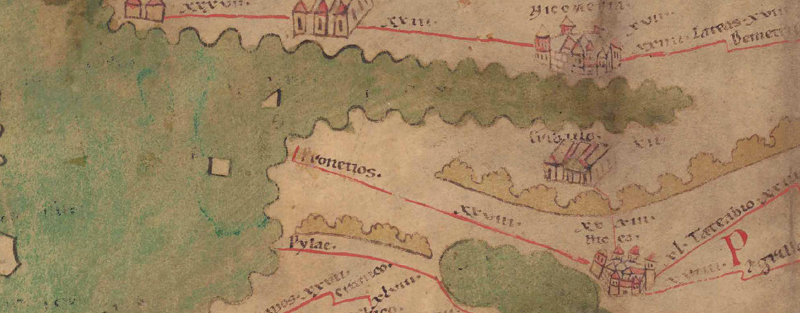 Al detalle de la imagen |
| Topónimo antes | |
| Topónimo después | XXVIII Nicea |
| Imagen alternativa | --- |
| Imagen (Barrington 2000) |
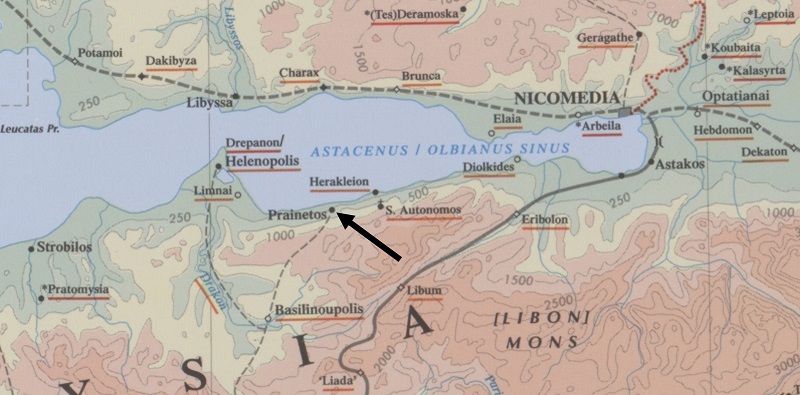 |
| Imagen (Scheyb 1753) |
 |
| Imagen (Welser 1598) | --- |
| Imagen (MSI 2025) | --- |
| Pleiades: | https://pleiades.stoa.org/places/511372 |
| Área: | Asia Menor |
| Tipo de topónimo: | Topónimo sin símbolo |
| Cuadrícula: | 8B2 |
| Color del topónimo: | negro |
| Tipo de viñeta: | --- |
| Itinerario: |
|
| Nombres alternativos (diccionarios): | Preietos (DNP) |
| Nombre A (RE): | Preietos 1 |
| Nombre B (Barrington Atlas): | Prainetos (52 F3) |
| Nombre C (TIR / TIB /otros): | Prainetos (TIB 13, 931-933) |
| Nombre D (Miller): | Pronetios |
| Nombre E (Levi): |
|
| Nombre F (Ravenate): | Pronesion (p. 91,35) |
| Nombre G (Ptolemaios): |
|
| Plinius: |
|
| Strabo: |
|
| Datación del topónimo en la TP: | Antigüedad Tardía (desde Diocleciano y siglo IV) |
| Fundamento para la datación: | Datierung: Die Orientierung des Ortes gegen Constantinopolis zusammen mit der Warenlager-Vignette lässt auf eine Zeit schließen, in der Konstantinopel bereits Hauptstadt und Prainetos eine wichtige Verkehrsstation dorthin war. Auch die antiken Belegstellen deuten auf die Spätantike (frühester Beleg bei Plin. nat. 31,23, jedoch unter einer anderen, älteren Namensform, dann erst wieder in spätantik/frühbyz. Texten). |
| Comentario al topónimo: |
Die Endung des Namens lässt vielleicht auf eine griech. Vorlage schließen. |
| Bibliografía: |
Bondoux, R.: Les Villes, in: Geyer, B./Lefort, J. (Hgg.): La Bithynie au Moyen Âge (= Réalités Byzantines 9), Paris 2003, 377–409, hier: 403f. |
| Última elaboración: | 01.07.2025 16:39 |
Cite this page:
https://www1.ku.de/ggf/ag/tabula_peutingeriana/trefferanzeige_es.php?id=1229 [zuletzt aufgerufen am 19.04.2026]