deutsch englisch spanisch französisch italienisch
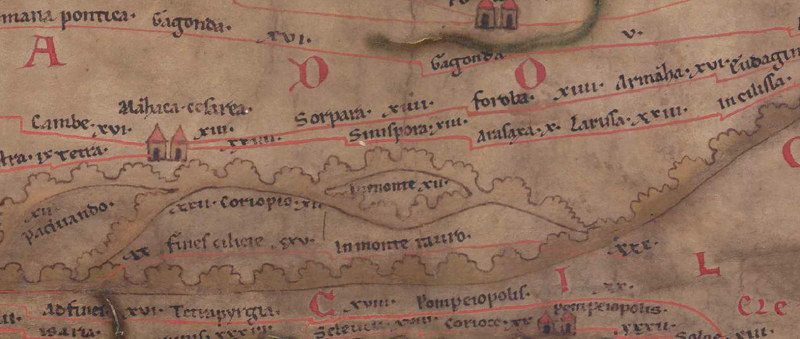
Ausschnitt aus der Tabula Peutingeriana - Rom

Tabula Peutingeriana – Pantalla individual

Topónimo (simplificado):

Inmonte (In monte)

Nombre (moderno):


Imagen:
Al detalle de la imagen
Topónimo antes XI     Coriopio     
Topónimo después XII     Fines cilicie     
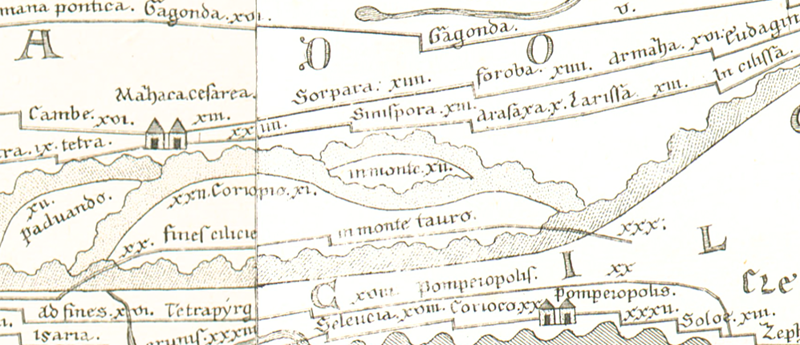
Imagen alternativa ---
Imagen (Barrington 2000) ---
Imagen (Scheyb 1753)
Imagen (Welser 1598) ---
Imagen (MSI 2025) ---
Pleiades: https://pleiades.stoa.org/places/652342
Área:

Asia Menor

Tipo de topónimo:

Topónimo sin símbolo

Cuadrícula:

9B3

Color del topónimo:

negro

Tipo de viñeta:

---

Itinerario:


Nombres alternativos (diccionarios):


Nombre A (RE):

In Monte 1

Nombre B (Barrington Atlas):

In Monte (66 unlocated)

Nombre C (TIR / TIB /otros):


Nombre D (Miller):

In Monte

Nombre E (Levi):


Nombre F (Ravenate):


Nombre G (Ptolemaios):


Plinius:


Strabo:


Datación del topónimo en la TP:

---

Fundamento para la datación:


Comentario al topónimo:

Das Toponym ist malerisch eingebettet in die Bergsymbole #109E and 109F – sicherlich nicht zufällig, wie Talbert aufgefallen ist (s.
https://www.cambridge.org/us/talbert/talbertdatabase/TPPlace2326.html). Es handelt sich um eines der dekorativ-spielerischen Momente auf der TP.

Diese Station ist sonst unter diesem Namen nicht belegt.

Der Ort lag wahrscheinlich an der Straße durch die Kilikischen Pforten, ist aber aufgrund der unklaren Zeichnung auf der TP nur vermutungsweise in der Nähe des Passes zu suchen laut Ruge, RE 1558.

ItMiller 665 schlägt zwei Alternativen zu einer näheren Bestimmung von Inmonte vor, das er angesichts der Entfernungsangaben nicht für einen Gebirgspass hält:
- entweder handele es sich um ein Mißverständnis von “mons Ucrinae”, und Inmonte sei somit gleichzusetzen mit mansio Mansucrinae ItBurd 579,1 (dort ebenfalls 12 Meilen entfernt von Tarsos) = Nampsucrone im ItAnt 145,5 (dort 27 Meilen von Podando = 9B2 Paduando) = Μόψου κρήνη bei Ptol. 5,7,5 bei = Μοψουκρήνη bei Sozom. hist. eccl. 2,47 = Mobsucrenae (mit zahlreichen variae lectiones), der letzten Station Cilicias am Fuße des Taurus bei Amm. Marc. 21,15,2 (petit per uias difficiles Mobsucrenas, Ciliciae ultimam hinc pergentibus stationem, sub Tauri montis radicibus positam), wo Kaiser Constantius starb (von TIB 5, 359f wird Mopsukrenai beim Dorf Kırıtlar lokalisiert, wo archäolog. Reste auf eine röm. Weiler hindeuten, der vielleicht noch in frühbyz. Zeit bestand. TIB nimmt jedoch anscheinend keine Identität mit Inmonte an).
- oder der Ort liege “seitlich von Mopsucrenae; j. nördlich von Beriramlü oder Tanifa Kischla, welches auf dem Berge liegt”.

Eine sichere Lokalisierung erscheint zur Zeit nicht möglich.

Meilenangabe nach Tarso cilicie: XII (12)
Die Straßenlinie wurde offenbar vergessen und die Meilenzahl XII steht merkwürdigerweise sehr dicht neben dem Toponym Inmonte, statt weiter vorne an der Strecke.
(s. Talberts Kommentar https://www.cambridge.org/us/talbert/talbertdatabase/TPPlace2326.html).

Der hier angedeutete Weg war offenbar schwierig (Amm. 21,15,2, s. o.; zu der Strecke s. auch Amm. 25,10,2 exornari sepulchrum statuit Iuliani in pomerio situm itineris, quod ad Tauri montis angustias ducit).


Kommentar (Talbert):
Presumably it is design, not accident, that the name Inmonte is encircled by mountain ranges #109E and 109F.
-> Stretch to Tarso cilicie
The linework for this stretch is not marked.
If this stretch should indeed link Inmonte with Tarso cilicie, as seems likely, it is curious that the distance figure XII is placed so close to the name rather than further along the stretch.

Miller, Itineraria, Sp. 665:
In monte, nach den Entfernungen ist hier nicht an den Gebirgspass zu denken, sondern entweder ein Mißverständnis von mons Ucrinae, somit gleichzusetzen masnio Mansucrinae (Hi), Nampsucronae (It), Mopsucrenae (Pt, Soz, Am), der letzte Ort Ziliziens, hier starb Kaiser Konstantius (Am). Oder in Monte ist seitlich von Mopsucrenae; j. nördlich von Beriramlü oder Tanifa Kischla, welches auf dem Berge liegt. 12, it. (Hi – von Mansucrine aus), i. (It), per vias difficiles (Am). Bei Tarsus „In pomoerio situm itineris, quod ad Tauri montis angustias ducit” ist das Grab (Am).

Datierung (Barrington):
In Monte - Late Antique

Bibliografía:

Miller, Itineraria, Sp. 665.

Ramsay, W. M.: Cilicia, Tarsus, and the Great Taurus Pass, The Geographical Journal 22,4 (1903), 357-410, hier: 408.

Ruge, W.: In monte 1, RE 9,1 (1916), 1558.

   [Standard-Literatur-Liste im PDF-Format]

Última elaboración:

24.08.2025 22:23


Cite this page:
https://www1.ku.de/ggf/ag/tabula_peutingeriana/trefferanzeige_es.php?id=1440 [zuletzt aufgerufen am 17.04.2026]

Derechos Política de privacidad